On the Treshold
A Door Open to Mystery
Myth lies at the origin of the world and keeps it in order. Cast into oblivion by all-powerful rationalism and materialism, we forget that it could revitalise our societies. Myth is present throughout my work. This series, which is set to expand, complements the earlier ‘birthing the Self’ collection. It emerged whilst I was reading Annick de Souzenelle’s book ‘The Inner Oedipus’...
NB : Click on an image to enlarge it and access additional explanations.


The Minotaur
The Minotaur, a horned monster, is the ‘guardian of the path leading to the sealed treasure of the underworld’. He symbolises our animal nature, which must be acknowledged and transmuted. He vanishes only if subdued by a pure heart wielding the golden sword.
He is placed in the path of the hero Theseus to help him achieve his royal, and thus divine, stature. But Theseus, blinded by hubris, goes astray by taking advantage of Ariadne’s help to to circumvent the trial, failing to grasp the importance of a fair confrontation.
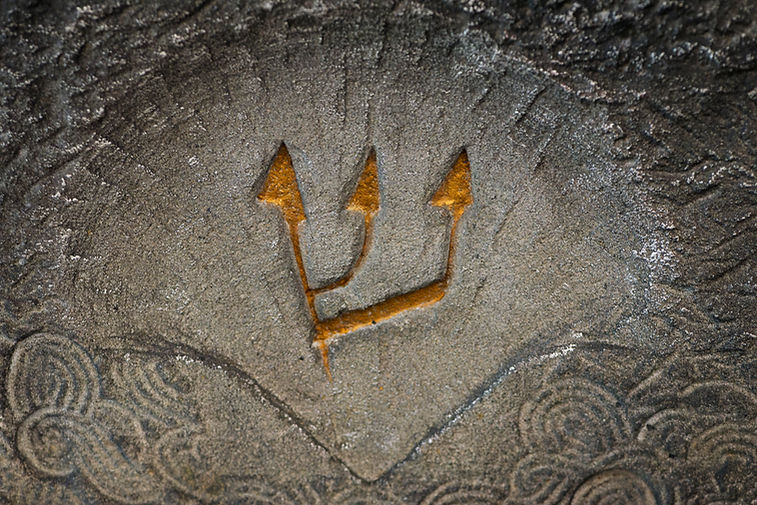
The trident on the plinth, the letter Shin, recalls the monster’s divine lineage and symbolises the Sacred Fire. It alone can bring about the hero’s inner transformation if he agrees to face his fears and rise to the challenge. This matrix of fire, the forge of Hephaestus, is depicted in the background photograph.
acacia, sandstone, charcoal, 24-carat gold,
227x70x90 cm, photograph 90x135 cm – 2025
Theseus,
The Modern Man
Archetype of the headless man, for lacking symbolic intelligence—that of the heart—he stands defenseless before the profound meaning of the trials he faces.
Swollen with pride, convinced he already knows, he is incapable of learning or evolving within the labyrinth of his life. “Theseus would wish to live without dying; he would wish for the fruit without becoming it,” as Annick de Souzenelle further writes.
Believing himself already arrived at the highest degree of accomplishment, he fails utterly in his existential quest, precipitating the fall of his kin and wandering endlessly through the meanders of his psychological labyrinth.


oiled acacia
180x54 cm - 2023


Hubris,
Atlas of the Modern World
The modern world, bolstered by its technology and knowledge, believes itself omnipotent, yet it is but a colossus with feet of clay, hollow and void of meaning.
Addicted to hydrocarbons, it sits enthroned upon a pipeline and a gear wheel, symbols of both its genius and its dependency.
Its horned and organic appearance accentuates the hostile and unsettling expression emanating from this ravenous geophage.
With a dark gaze, it defies the mineral world, which exists for all eternity. The latter observes this pathetic Atlas of modern times with mockery, anticipating its fall.
acacia, steel, brass
172x60 cm, photograph 40x60 cm - 2024
The Maze
The labyrinth represents the tool for the realization of the Great Work. It symbolizes life as a field of consciousness to be explored, with its false paths and dead ends. We wander there for a long time before accomplishing the immense potential of our inner cosmos.
These slow inner fecundation and maturation processes resemble a conquest. The resulting wandering is suggested on the stone, extracted from a ruined house, by a motif that emerges progressively. Lichens and mosses coexist there with various stigmas of time, blending into the more recent traces of sculpture—evanescent furrows of the existential quest.
At the center, the quadrilateral. Processional stairs descend into it, like into an inverted ziggurat. Finally, at the heart of the sanctuary, a slender golden vortex.


stoneware, pigments, 24-carat gold
75x38x15 cm - 2025